


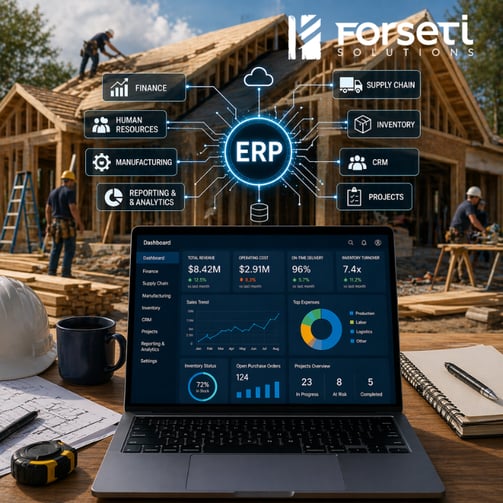
If you’ve ever taken on a home renovation, you already understand the risks of an ERP implementation, whether you realize it or not.
You start with a vision. A budget. A timeline. Maybe even a Pinterest board full of ideas.
Then reality hits.
Costs creep up. Timelines stretch. Unexpected issues pop up behind the walls. Suddenly, what was supposed to be a “quick upgrade” turns into a months-long overhaul.
Sound familiar?
Now imagine that same scenario, but instead of a kitchen remodel, it’s your entire business operation.
That’s ERP.
And just like home renovations, ERP projects fail more often than most companies expect.
The Alarming Reality of ERP Failure Rates
Before diving into the “why,” it’s important to understand the scale of the problem.
- 55% to 75% of ERP projects fail to meet their objectives, according to industry research
- Over 70% fail to achieve their original business goals
- Only 25% are completed on time and within budget
In other words, most ERP projects don’t deliver what companies expect, whether that’s ROI, efficiency, or long-term scalability.
And just like a renovation gone wrong, the damage isn’t always obvious at first. It shows up over time, in inefficiencies, workarounds, frustrated teams, and missed opportunities.
Why ERP Projects Fail (Just Like Renovations)
Let’s break down the similarities.
1. The “It’s Just a Simple Upgrade” Mindset:
Homeowners often underestimate renovations:
“We’re just updating the kitchen.”
Then they open a wall and discover outdated wiring, plumbing issues, or structural problems.
ERP projects suffer from the same thinking.
Companies assume they’re “just implementing software,” when in reality, ERP touches:
- Finance
- Operations
- Supply chain
- Inventory
- Reporting
- Customer data
ERP isn’t a tool. It’s a business transformation.
When organizations treat it like a basic IT project, failure becomes much more likely.
2. Poor Planning and Undefined Requirements:
In renovations, vague plans lead to costly changes mid-project.
In ERP? It’s even worse.
A major cause of failure is unclear business requirements and process mapping.
Without clearly defining:
- Current workflows
- Desired outcomes
- Data structures
- Integration needs
Teams end up constantly reworking configurations, adding complexity, and blowing through budgets.
3. Scope Creep (The Silent Killer):
You planned to redo the kitchen. Now you’re also updating the flooring, repainting the house, and replacing cabinets.
ERP projects follow the same pattern.
- “Let’s customize this module.”
- “Let’s add another integration.”
- “Let’s change workflows mid-implementation.”
Each change adds time, cost, and risk.
And the numbers back it up:
Many ERP projects exceed budgets by 3–4x the original estimate.
4. Underestimating Complexity:
Renovations often uncover hidden challenges. ERP projects are built on them.
ERP implementation requires aligning:
- Business processes
- Data structures
- Technology systems
- Organizational change
A lack of understanding around these complexities is one of the biggest contributors to failure.
In fact, poor process alignment is a major reason ERP systems don’t deliver value.
5. Lack of Skilled Guidance:
Would you renovate your home without a contractor?
Probably not.
Yet many businesses attempt ERP implementation with:
- Limited internal expertise
- Overextended IT teams
- Generic consultants
ERP is not just about installing software. It’s about designing how your business runs.
Without experienced guidance, projects stall, misalign, or fail.
The Hidden Costs of ERP Failure
ERP failure doesn’t always mean the system shuts down completely.
More often, it results in:
- Inefficient workflows
- Manual workarounds
- Poor data visibility
- Higher operational costs
Some organizations even see:
8–12% higher operating costs due to underperforming ERP systems. And just like a poorly done renovation, fixing it later is often more expensive than doing it right the first time.
How to Avoid ERP Failure
Here’s the good news: ERP success is absolutely achievable, with the right approach.
1. Treat ERP as a Business Transformation:
ERP is not an IT project.
It’s a strategic initiative that should be tied directly to business outcomes like:
- Improved efficiency
- Better decision-making
- Reduced costs
- Scalable growth
Successful organizations align ERP with business strategy from day one.
2. Define Clear Goals and Processes:
Before selecting or implementing an ERP system, you need clarity on:
- What problems are you solving
- How your processes should work
- What success looks like
This reduces rework, minimizes customization, and keeps the project on track.
3. Limit Customization:
Customization is tempting, but dangerous.
The more you customize, the more complex and fragile your system becomes.
Instead, focus on:
- Adopting best practices
- Configuring instead of customizing
- Streamlining processes
4. Prioritize Data and Integration:
ERP success depends heavily on clean, connected data.
Disconnected systems and poor integrations are a major cause of failure.
That’s why an integration strategy is critical, ensuring your ERP connects seamlessly with:
- CRM systems
- Financial tools
- Supply chain platforms
- Operational systems
5. Work with an Experienced ERP Integration Partner:
This is where the biggest difference is made.
An experienced partner, like Forseti Solutions, does more than implement software.
They help you:
- Align ERP with business goals
- Design efficient workflows
- Integrate systems seamlessly
- Avoid common pitfalls
- Optimize performance long-term
Forseti Solutions specializes in helping organizations maximize the value of their ERP systems, particularly through deep expertise in IFS and complex integrations.
Instead of treating ERP as a one-time project, they focus on continuous improvement, optimization, and long-term success, which is exactly what most organizations are missing.
The Right Way to Approach ERP
Think of ERP less like a renovation and more like building a foundation.
Because that’s what it is.
When done right, ERP becomes:
- The backbone of your operations
- A single source of truth
- A driver of growth and efficiency
But when done wrong?
It becomes an expensive, frustrating system that never quite delivers.
Build It Right the First Time
ERP projects don’t fail because of the software.
They fail because of:
- Poor planning
- Misaligned goals
- Lack of expertise
- Weak integration strategies
The companies that succeed take a different approach.
They invest in strategy. They prioritize alignment. And most importantly, they partner with experts who understand how to turn ERP into a competitive advantage.
Because just like a home renovation, it’s not about starting the project. It’s about finishing it the right way.
Ready to avoid costly ERP mistakes and build a system that actually works for your business?
Contact Forseti Solutions to start your ERP journey with a strategy-first approach that drives real results.