

When your systems, data, and processes are aligned, your organization glides.
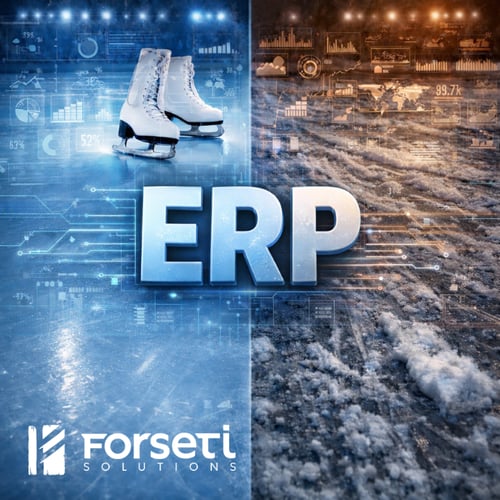
Every four years, the world watches Olympic figure skaters glide across pristine ice.
Under bright lights and global pressure, their movements appear effortless, clean turns, precise landings, flawless execution. What most viewers don’t see is what happens before the performance.
The ice is freshly resurfaced.
The surface is carefully prepared.
Timing is intentional.
Because in competitive skating, surface conditions matter.
As the day progresses and more athletes take the rink, the ice changes. Blades carve grooves. Edges roughen. Snow builds up. What was once smooth becomes uneven, making precision harder and increasing the margin for error.
ERP implementations follow a similar pattern. Early in a company’s transformation journey, conditions are clearer. Processes are less tangled. Data is easier to manage. Alignment is simpler to achieve.
But the longer organizations delay modernization, the more operational “skate marks” accumulate, legacy systems, manual workarounds, disconnected reporting, and resistance to change.
By the time leadership decides it’s time to transition, the ice is often no longer fresh. And that’s when projects can feel unexpectedly difficult.
The good news? Experienced partners like Forseti Solutions understand how to anticipate these surface conditions and how to resurface the ice before complexity disrupts performance.
The “Fresh Ice” Phase: When ERP Is Strategic, Not Reactive
In the early stages of ERP planning, organizations have the advantage of clarity. Processes are still manageable. Data structures are simpler. Teams are more adaptable.
When ERP modernization is proactive, businesses can:
- Define future-state processes before pain becomes urgent.
- Clean and standardize data before migration.
- Align leadership on long-term operational goals.
- Budget strategically instead of reacting to crises.
This is the equivalent of stepping onto newly resurfaced ice, smooth, predictable, and ready for confident movement.
However, many organizations wait until friction becomes unavoidable.
When the Ice Gets Choppy: What Happens Over Time
ERP systems rarely fail overnight. Complexity builds gradually.
- Disconnected reporting tools
- Manual workarounds
- Shadow spreadsheets
- Outdated integrations
- Multiple versions of “truth”
The longer these patterns persist, the more operational grooves are carved into the organization.
What “Choppy Ice” Looks Like in ERP Projects:
- Data migration becomes significantly more complex.
- Business process alignment requires rework instead of refinement.
- Employees resist change due to past frustrations with the system.
- Integrations multiply and become harder to untangle.
- Decision-making slows due to unclear ownership.
By the time implementation begins, companies aren’t just installing new software. They are undoing years of accumulated friction.
That’s why timing matters.
Did You Know? According to industry research, up to 46% of ERP projects experience schedule delays and 56% experience budget overruns when scope and data complexity aren’t addressed early.
Why Waiting Makes ERP Harder
Manufacturers and distributors often delay ERP transitions because “the current system still works.” But “working” and “working well” are very different. Over time, several compounding factors increase implementation difficulty:
1. Data Debt: Years of inconsistent data entry, duplicate records, outdated SKUs, and disconnected databases create migration risk.
2. Process Drift: As teams create workarounds, processes become personalized rather than standardized. When it’s time to modernize, alignment requires cultural recalibration.
3. Integration Sprawl: Point solutions multiply: CRM, warehouse tools, finance platforms, production software, increasing integration complexity.
4. Organizational Fatigue: When teams have experienced past technology frustrations, skepticism grows. Change resistance isn’t about the new system; it’s about old scars.
By the time leadership commits to transformation, the “ice” has been skated on for years.
This is where experience matters.
The Forseti Approach: Resurfacing Before You Skate
At Forseti Solutions, ERP implementation isn’t treated as a last-minute scramble. It’s approached as a controlled resurfacing process.
Rather than reacting to friction, Forseti applies lessons learned from previous transitions to reduce risk early.
What that looks like in practice:
Strategic Discovery Before Configuration: Understanding operational realities before touching system settings.
Data Assessment Before Migration: Identifying data quality gaps early, not during go-live week.
Process Mapping Before Automation: Clarifying what should be standardized versus optimized.
Executive Alignment Before Execution: Ensuring leadership owns transformation decisions.
This structured sequencing prevents minor grooves from becoming operational ruts.
For manufacturers and distributors implementing modern ERP platforms such as IFS, preparation determines whether implementation feels controlled or chaotic.
ERP Is Not Just a Technology Upgrade
One of the most common misconceptions about ERP transitions is that they are software projects.
They are not.
They are operational redesign initiatives. The software is simply the vehicle.
When companies treat ERP as a technology installation, they underestimate the business transformation required. But when they treat it as enterprise realignment, success rates increase significantly.
ERP touches:
- Inventory visibility
- Production planning
- Procurement strategy
- Financial controls
- Reporting accuracy
- Customer responsiveness
If those foundations aren’t leveled before go-live, the transition will feel unstable, no matter how advanced the system is.
Smooth Ice Creates Strategic Agility
When ERP implementation is proactive and properly sequenced, the results are transformative.
Organizational experience:
- Real-time inventory accuracy
- Standardized reporting across locations
- Improved forecasting
- Reduced manual reconciliation
- Faster decision-making
- Scalable operational frameworks
Instead of navigating ruts, teams glide.
And agility matters more than ever in manufacturing and distribution environments where supply chains, labor markets, and customer expectations shift rapidly.
The Competitive Advantage of Experience
Every ERP implementation contains unknowns. But not every challenge is new. Many friction points, scope creep, unclear ownership, and data surprises are predictable.
What differentiates a smooth transition from a choppy one is whether your partner has already navigated those conditions before.
Experienced ERP professionals, like Forseti, understand:
- Where clients typically underestimate effort
- When decision fatigue begins to slow progress
- How data inconsistencies surface late
- Why executive communication cadence matters
- Where change management must be reinforced
In short, they know how ice deteriorates and how to prevent it.
Evaluating the Condition of Your Ice:
If your organization is considering ERP modernization, ask:
- Are we planning proactively, or reacting to friction?
- Have we assessed data quality recently?
- Are our processes standardized across departments?
- Do we have executive alignment on transformation goals?
- Are we treating ERP as a business strategy, not just a system replacement?
The earlier these questions are addressed, the smoother your transition will be.
Just like an ice rink at the Olympics, the condition of the surface determines how confidently you can perform.
Control the Surface, Control the Outcome
ERP transitions don’t become difficult overnight. They become difficult gradually, as operational grooves deepen and complexity accumulates. The smartest organizations recognize that smooth transitions aren’t accidental. They are engineered.
With strategic preparation, structured sequencing, and an experienced partner like Forseti Solutions, your ERP journey doesn’t have to feel like navigating end-of-day ice.
It can feel controlled. Predictable. Strategic. And smooth from the start.
Ready to keep your ERP transition smooth?
Let’s resurface your strategy before friction slows you down. Contact Forseti Solutions to build a proactive ERP roadmap that reduces risk and delivers long-term value.